5 Things You May Not Know About Blackmoor Golf Club (But Should)
 One course. One legend. One Civil War graveyard. This is not your average South Strand layout.
Blackmoor Golf Club doesn’t always get top billing in the Grand Strand conversation. Nestled in Murrells Inlet along the Waccamaw River, it sits quietly south of the main Myrtle Beach corridor, where the crowds thin out and the golf gets genuinely interesting. Most people know it’s a solid layout with great conditions and a fair price. What most people don’t know is the story beneath the surface — and it’s a good one.
It’s the Only Gary Player Course in the Myrtle Beach Area
The Grand Strand has hosted Arnold Palmer, Jack Nicklaus, Pete Dye, Tom Fazio, Rees Jones, and a who’s-who of the design world. But it has exactly one Gary Player signature course: Blackmoor. One.
Player — known worldwide as the “Black Knight” for his trademark all-black attire — opened Blackmoor in 1990, and it remains his sole mark on the Grand Strand. That alone should get it more attention than it typically receives. When a Hall of Fame player who has won nine major championships and traveled more than 14 million miles for golf (more than any other athlete in history) shows up in your market and builds one course, that course is worth knowing.
There’s also a quiet irony in the name that the Black Knight designed a course called Blackmoor. Coincidence or intent — either way, it’s a detail worth appreciating.
The Ground Beneath It Has Centuries of History
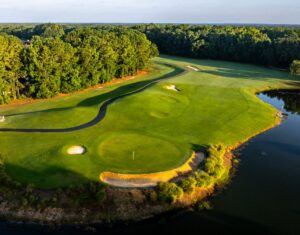
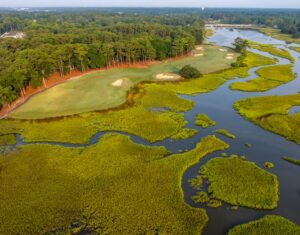
Blackmoor wasn’t built on a blank piece of land. It was built on Longwood Plantation, an antebellum rice plantation that once ran along the Waccamaw River in the South Carolina Lowcountry. The land’s agricultural past is still visible in the lay of the course — the river views, the wetlands, the moss-draped oaks that frame nearly every hole. Player didn’t fight the terrain. He designed around it.
The result is a layout that feels less like a constructed golf course and more like a place golf was always meant to be played.
There’s a Civil War Graveyard on the 13th Hole
This one stops people mid-sentence.
Running down the left side of the par-5 13th hole — 478 yards from the white tees — is an old cemetery dating back to the 1800s. It’s fenced off, listed on the National Historic Registry, and part of the original Longwood Plantation grounds. A wayward tee shot on 13 doesn’t just find trouble. It finds history.
The good news: players are granted free relief from the cemetery. The better news: there’s a story to tell in the 19th hole that almost no other golf course in America can match.
The 8th Hole Is a Risk-Reward Classic
Gary Player’s design philosophy leans Scottish — doglegs, natural hazards, precision over power — and nearly half of Blackmoor’s 18 holes feature a dogleg of some kind. But the par-4 8th is the one that separates the confident from the cautious.
Played conventionally, the hole is a 370-yard dogleg right that leaves a short iron into a large, receptive green. Easy enough. But a second option opens up for the bold: a 270-yard line straight through a 30-yard-wide chute in the trees, with the green sitting just on the other side. Thread that needle and you’ve got a legit eagle look. Miss the chute, and you’re writing a number you’d rather not think about.
It’s exactly the kind of hole Player has championed his entire career — one that rewards skill and punishes recklessness, without making either feel arbitrary.
The Course of the Year That Deserved More Buzz
In 2001, Blackmoor was named Myrtle Beach Golf Course of the Year by the Myrtle Beach Area Golf Course Owners Association — recognition that the course’s combination of conditions, design, and value had earned it a place among the Grand Strand’s best. A significant renovation followed in 2003: greens, bunkers, clubhouse, and strategic tree removal that opened up several fairways and improved playability throughout.
And presiding over all of it, for more than 30 years running, has been General Manager Bob Zuercher — a continuity of leadership that is, quietly, one of the reasons the course has stayed as good as it is.
Blackmoor isn’t trying to be the loudest name in Murrells Inlet. It doesn’t need to be. It has a Hall of Fame designer, 35 years of history on land that predates the Civil War, a graveyard at the 13th, and one of the most cleverly designed risk-reward holes on the South Strand.
That’s more than enough.