I think it’s safe to say that my 2014 season has come to a close. A tour caddie that is supposed to be retired, I still worked ten tournaments this year. That may be a little more than I planned or wanted to do, but I have to admit, I enjoyed every one of them.
From getting kicked out of The Masters (something I'm actually quite proud of) to being part of winning the silver medal with Matt Fitzpatrick at the US Open to working for my old boss, Johan Edfors, in far flung Azerbaijan, to working this week at the only PGA event in Mexico, all of them have been great. The problem with retiring from 30 plus years of being a tour caddie is all your friends are on tour and you end up never getting to see any of them. These few weeks back out gave me the opportunity to catch up with all my mates.
Wouldn't have missed that for anything.
The week in Mexico was particularly enjoyable for me as I always enjoy doing the unusual events, and I think a PGA Tour event being held in Mexico falls into that category.
It was also quite nice because I was working for a new player for me. In this caddying world, we tend to end up in certain “stables.” Taking me as an example, I've worked for 22 different Swedes in my career. You do a good job on the bag for one of them and the next thing you know you've gone through the whole stable of them.
I've also bagged for quite a few Spaniards, and this week I got an opportunity to work for a big name player, Gonzalo Fernández-Castaño (you have to admit, that's a big name!). How I ended up on the bag was sort of interesting as well.
After working for Matt Fitzpatrick at the French Open, Matt's management group decided since I wasn't caddying fulltime anymore they needed to get someone else on that bag, and I went back to looping for Johan Edfors.
A few weeks went by when I got a call from Matt saying he wasn't getting on so well with his new caddie and would I come out and work for him at the Dutch Open. This was great news for me as the Dutch Open is one of my favorite weeks on tour. The tournament was being held at Kennemer Golf Course, which is arguably one of the best courses on continental Europe. It's a Harry Colt designed layout and if you ever get a chance to play it, don't pass it up.
Well, as it turned out Matt and I had the locker right next to Gonzalo. One afternoon I got back to the locker in time to hear Gonzalo's caddie telling him that he really didn't fancy flying all the way from China to Mexico and then flying all the way back to Japan. I gave his caddie a little nudge in the ribs and told him I would be more than happy to do that week for him.
We had a laugh and nothing more was said about it. But three weeks later I got an email from Gonzalo asking me if I was available to bag for him the week of the Mayakoba? Great, I was back in the Spanish stable!
I've actually done this tournament twice before when it was just a Web.com event. As coincidence would have it, I also worked that week for a Spanish player, Alejandro Canizares, who's the son of the legendary Spanish golfer, Jose Canizares. In a lazy sort of way, it is always nice to come…
Read MoreIt’s Thanksgiving week and we are our counting blessings as we await the eighth episode of Big Break Myrtle Beach. There are only six contestants remaining, and Charlie, the favorite in our eyes, still holds the super immunity he earned in episode one. Will Jimmy, who hasn’t earned immunity since week two, get sent home or will he rise to the challenge yet again? The mercurial Anthony promises a fireworks show, so there should be no shortage of drama. Enjoy a preview of episode eight.
Read MoreAre you planning a few practice shots through window ruins at Barefoot Resort’s Love Course? If you’ve been watching Big Break Myrtle Beach on Golf Channel, I bet you are. My guess is the marshals will be somewhat forgiving if they see you do it.
It’s particularly fun to play a course – and hit a shot – that you’ve seen the pros tackle. On the Grand Strand, The Dunes Golf and Beach Club (Senior Tour Championship), TPC of Myrtle Beach (Senior Tour Championship) and Wachesaw East (four LPGA Tour events) quickly come to mind.
Read MoreA road trip was taken, a clear favorite emerged, and the cruelty of the game of golf was reaffirmed on the seventh episode of Big Break Myrtle Beach.
First the road trip: after playing at Barefoot Resort & Golf the first half of the season, Big Break moved to Pawleys Plantation, one of the most scenic and challenging courses along the Grand Strand.
Read MoreBig Break Myrtle Beach changes venues for episode seven, taking the show to one of the area’s most scenic courses, the Jack Nicklaus designed Pawleys Plantation. With the number of contestants dwindling, the stakes and pressure are rising. Check out the sneak peek below and tune in to Golf Channel Tuesday night at 9 p.m. to see how the players fare on Pawleys Plantation, one of the area’s most scenic and challenging courses!
Read MoreFormer PGA Tour Player Hugh Royer III, who is the director of instruction at South Carolina Golf Center, shows you how to hit one of golf’s most valuable and vexing shots – the knockdown into the wind. Royer’s tip – hint setup dictates success – will have you relishing the opportunity to play in the wind.
These Myrtle Beach golf schools can turn yourLower your handicap, fine-tune your advanced skills, or build a solid foundation for a golf game that will serve you for a lifetime. Wouldn't that just be the perfect Myrtle Beach souvenir? Check it out! And, don't forget, you can get these tips by email too!
Read MoreThe Intracoastal Waterway provides a stunning backdrop for a round of golf, and seven Myrtle Beach courses play along the man-made body of water that runs from Maine to Miami. Enjoy a look at some of the prettiest courses on the East Coast.
Great shots and a squandered opportunity defined the sixth episode of Big Break Myrtle Beach.
Just eight players remained and the first part of the immunity challenge took place on one of Myrtle Beach’s most popular holes, the fourth on Barefoot Resort’s Love Course.
Read More
Golf is an aspirational game. We all dream of playing the best of the best, and no destination provides more opportunities to make that dream a reality than Myrtle Beach.
Golfweek provided further affirmation of Myrtle Beach’s place atop the golf travel market with its ranking of America’s Top 100 Resort Courses. The list which was unveiled in the magazine’s Ultimate Guide to Golf Course Living and Great Escapes issue, ranked three area courses among the nation’s top 100, led by a pair of top 30 layouts.
Leading way was Caledonia, which was the 24th ranked Resort Course in America, followed closely by the Dunes Club at No. 26 and the Moorland Course at Legends Resort, which was 85th.
The Dye, Love and Fazio courses at Barefoot Resort & Golf were all ranked among the next 100, further validating the depth and quality of Myrtle Beach’s golf offerings.
A consensus top 100 layout, Caledonia is an unforgettable combination of Mike Strantz’ architectural genius and a stunning piece of lowcountry South Carolina property. Caledonia plays through soaring live oak trees draped in Spanish moss and along the Waccamaw Neck, a body of water that used to be home to a thriving rice plantation.
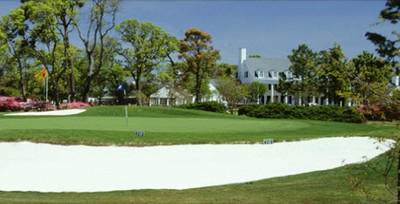
The 18th hole, which requires a forced carry into a green that rests in the shadow of an antebellum style clubhouse, is universally regarded as among the finest in golf, but it’s only part of what makes Caledonia special.
The Dunes Club, a Robert Trent, Sr., masterpiece that helped put Myrtle Beach on the map, is the area’s most storied layout. The course, which features uncommon elevation change, wide fairways and daunting greens, has hosted the six Senior PGA Tour Championships, the U.S. Women’s Open, and most recently the PGA Professional National Championship.
Waterloo, as the famed 13th hole is known, is the Dunes Club’s signature hole and concludes a memorable three-hole stretch known as Alligator Alley. The 11th hole, which plays along marshy waters from the nearby Atlantic Ocean, is one of the area’s best and most scenic holes.
The Moorland Course at Legends is among the most popular courses in America, in addition to its critical acclaim. The P.B. Dye creation features expansive greens and uses imaginative bunkering to generate visuals. The course, which has been ranked among America’s 50 most difficult layouts, is most known for the par 4 16th hole, otherwise known as Hell’s Half Acre.
The 270-yard hole presents the ultimate risk-reward decision, offering players a shot at eagle or much, much worse for those who find the wrong bunker.
Read MoreThe sixth episode of Big Break Myrtle Beach touts a window of opportunity, both literal and figurative in this case, as the show moves to the Love Course at Barefoot Resort.
Read More
Golf holes don’t change very often – not the actual routing, anyway.
Sure, trees are trimmed and removed, new irrigation systems are put in the fairways and greens are sometimes reshaped and frequently planted with the best new grass available.
But blowing up a hole and starting over? Hardly ever done. Nobody wants to make the time and investment (shutting down the hole and/or course) and risk striking out.
Yet it has happened at several of the best Myrtle Beach golf courses. And with spectacular results.
A few of Myrtle Beach golf's most popular holes at some of its most high-profile courses bear little resemblance to their original form.
Here’s a few examples where starting over – or making dramatic changes – resulted in home runs:
As Big Break Myrtle Beach nears the halfway point, just how tenuous each player’s existence on the show is was brought into focus in Episode Five. Watch as one solitary second helped send a player home, and Charlie was forced to confront a $10,000 question.
Read MoreThe fifth episode of Big Break Myrtle Beach highlighted the importance of every second and left Charlie to ponder a $10,000 question.
As the season nears its halfway point, the familiar colored golf balls returned to the breakfast table as a way of determining teams for the day’s immunity challenge. Contestants choose a ball but were then forced to pass it to the person on their right.
Read MoreEpisode 5 of Big Break Myrtle Beach airs Tuesday night at 9 p.m. on Golf Channel and mystery is in the air. In the sneak peek (watch below), contestants sound bewildered.
Mix in images of players sprinting on the course and it appears that unexpected drama awaits us!
Read More
Dan Maples grew up in Pinehurst, N.C., immersed in the tradition of Carolinas golf. His father, Ellis, designed several of the top courses in the Carolinas. His grandfather, Frank Maples, was Donald Ross’ construction engineer on several legendary Sandhills courses, including renowned Pinehurst No. 2.
But Dan Maples created a legacy all his own in the Myrtle Beach area as a pioneer by designing spectacular courses that wind through breathtaking scenic marshes with holes that conclude with dramatic, uniquely shaped greens in a memorable setting. While previous architects tended to build away from wetlands, Maples weaved his holes through them.
Maples’ Myrtle Beach-area courses, which trace back to the unveiling of stunning Oyster Bay Golf Links in 1983, now number 10, stretching from Sunset Beach in the north down to Pawleys Island. The architect’s incorporation of wetlands into his routing ushered in a new era in Grand Strand golf, adding both beauty and difficulty to area layouts.
As Maples has said: “From the beginning, one of our goals has been to build courses that players could remember.”
Here’s a look at a memorable hole on each of Maples’ Grand Strand designs:
Heritage Club: The par-4 14th is one of the Grand Strand’s best driving holes, challenging players to gamble off the tee. Hit it right – the shortest carry over the water – and you’re left with a layup or long approach over water. Hit it short or too far left and you’re hitting 3 off the tee. A solid drive that doesn’t bite off enough dogleg goes through the fairway into woods. But a solid strike hit with a bit of bravery leaves a very manageable approach.
Man O’War: An island green sitting exposed in a 200-acre lake greets players at the par-3 17th. From an elevated tee, the approach with a mid-iron must navigate strong breezes over the water to the kidney-shaped putting surface.
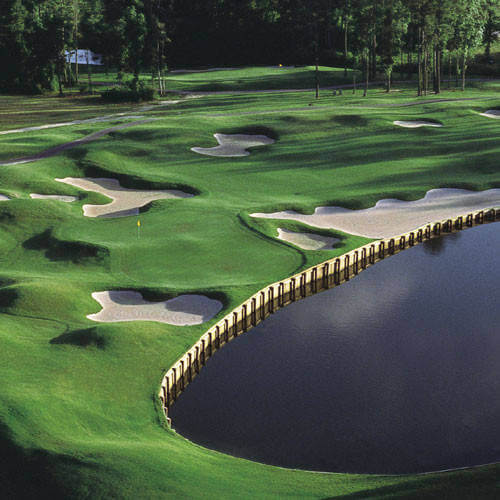
Oyster Bay: Several of the most photographed holes on the Grand Strand to pick from here. But there are few more thrilling shots anywhere than the short-iron approach on the par-3 17th, which features an island green surrounded by water and lined by oyster shells. Safely reaching the diagonally shaped green, which is at least one club further to the back, left side requires extreme accuracy and precise club selection.
Pearl East: The beautiful, but menacing Calabash River marsh extends the length of the left side of the long par-4 18th hole. One bunker serves as a buffer on the left, three others surround the green. Breezes off the marsh add more difficulty to the hole.
Pearl West: The par-5 finishing hole is one of the most iconic on the Grand Strand. Water bisects the fairway on the second shot, leaving players the option for a dangerous attempt to reach the green in two or a safe play left of the hazard, which still must be crossed on the third shot.
Sandpiper Bay: Maples proves with this 27-hole Sunset Beach, N.C. facility that a layout can have beautiful wetlands and other dangerous hazards while maintaining a high degree of playability. The short par-4 3rd hole on the “Sand” nine offers a great birdie opportunity for players who can hit an accurate tee shot over water to a narrow fairway, leaving just a pitch to the green.
Sea Trail Maples Course: At the long, par-4 7th, the tee shot must be hit right of water that bisects the dogleg left to leave a clear approach. The hole can’t be overpowered off the tee. Three bunkers guard against bailouts hit long and right of the fairway.
Willbrook Plantation: Make sure and get loosened up before your round. Willbrook begins with some of its toughest holes, leading to the short par-3 6th, which features a putting complex surrounded by water. Though the vertically shaped green is long, the green is elevated with the putting surface falling off toward the water and a large bunker that guards the left side.
The Witch: At the par-4 9th, players feel the full effect of golf in the eerie, black wetlands filled with cypress, reptiles and birds of prey. Drives don’t have to be long, but they have to be accurate to hit a fairway surrounded by wetlands. Tee shots hit off-target to the left leave a second shot over water and wetlands blocked by trees.
The Wizard: The par-4 finishing hole doesn’t just have an island green – it has an island fairway, too. So it’s actually an island hole. There’s a little more room for error on the left, but there’s an almost mystical push many players feel that sends drives to the right. The strong breezes off the large, centerpiece lake add to the challenge.
Read More