Myrtle Beach Golf Holes That Look Scarier Than They Actually Are
 Here’s something nobody tells you before your first Myrtle Beach golf trip: a lot of the most photographed, most talked-about holes in the area are designed to make you panic before you’ve even pulled a club. The visuals are doing the heavy lifting. The actual challenge, once you understand what the hole is really asking, is often far more manageable than the tee box view suggests. Here’s a fresh round of holes where your eyes are lying to you.
No. 1 at King’s North: The Opening Hole is Actually an Invitation
The first hole at King’s North sets the visual tone for the whole round: big, dramatic, and seemingly unforgiving. But the 459-yard par-5 opener is a great opportunity to make birdie. The hole is short, there is little stress on the first two shots, and there is only anxiety on the approach if the pin is tucked on the left side of the green, forcing you to flirt with a bunker. Arnold Palmer designed the course and he wanted you to get off to a good start. The drama on the scorecard at King’s North comes later. This one is an early gift; take it.
True Blue Golf Club: The Whole Course is More Forgiving Than It Looks
True Blue has a reputation that scares people off before they even tee it up. The Mike Strantz name, the massive bunkers, the scale of everything — it looks like a course designed to destroy you. True Blue has the Myrtle Beach area’s widest fairways, and its charms are many. The late Strantz has a deserved reputation for boundary-pushing designs (Tobacco Road and Royal New Kent) that are only borderline playable for all but the best players. That perception followed Strantz to True Blue. It’s a myth. The fairways are genuinely wide. The waste bunkers look ferocious but are easy to play from. First-timers almost always walk off surprised at how much fun they had. Trust the fairways.
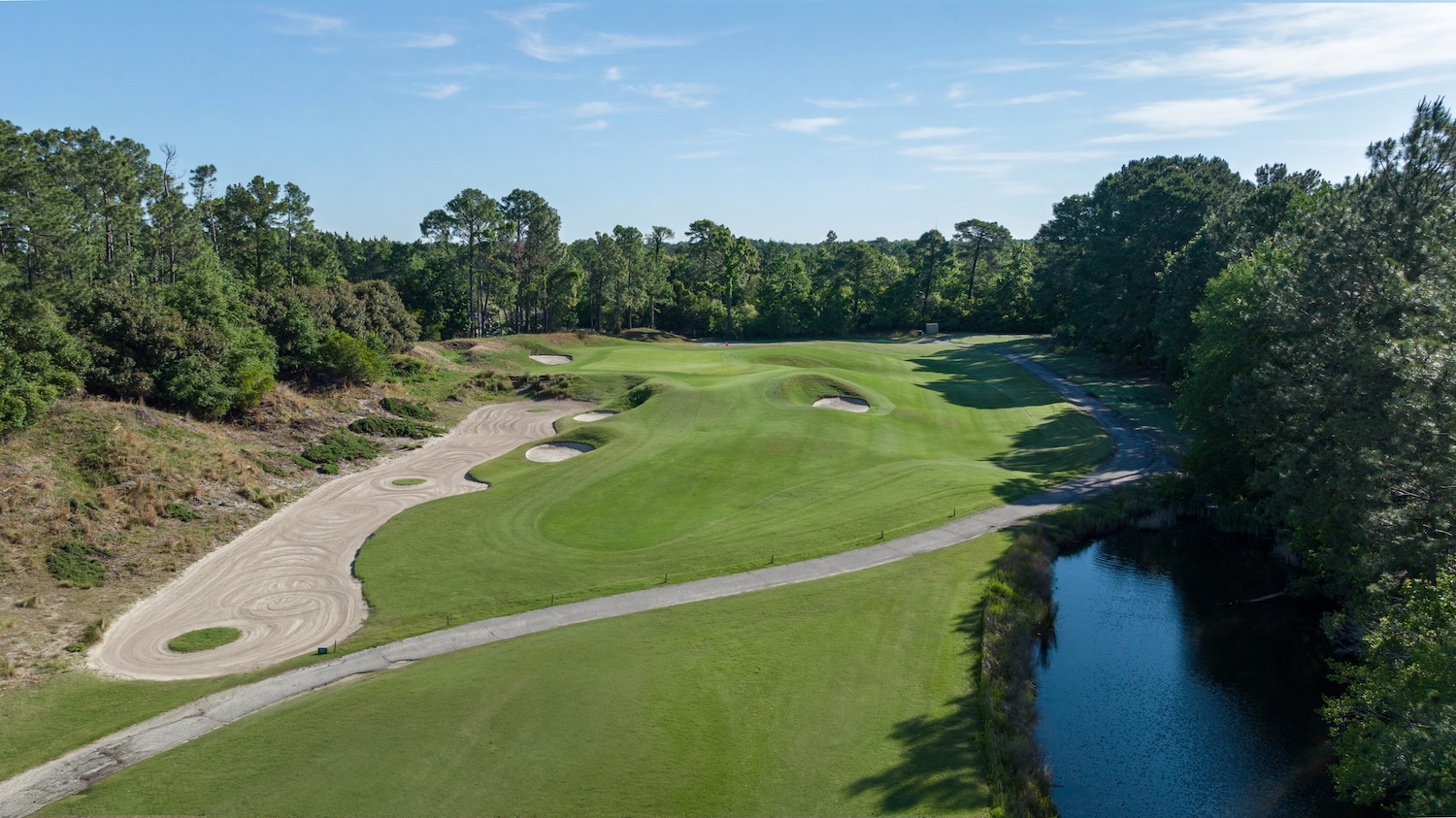
No. 16 at the Moorland Course at Legends Resort (pictured): “Hell’s Half-Acre” Has a Birdie in It
At 244 yards with a nickname like “Hell’s Half-Acre,” the 16th at Moorland sounds like a hole designed purely for punishment. The green is an inviting target, but potential calamity awaits in the form of pot bunkers and gnarly native grasses for those who miss. Here’s the thing, though: the green itself is generous, and for anyone who finds it, this is a legitimate birdie opportunity. The nickname does more psychological damage than the hole itself. Players who commit to their number and swing freely tend to fare far better than those who tentatively half-swing and find the pot bunkers. Attack it.
No. 14 at Wild Wing Avocet: A 265-Yard Par 4 That’s a Gift
The 14th on the Avocet Course at Wild Wing is a 265-yard par 4, go-time when you reach the tee. The aerial view makes it look like a minefield, but the reality is that the green is reachable for most players, there’s generous room in the landing area, and even a conservative layup leaves a very short approach. It’s the kind of hole where bogey feels like a failure and birdie feels genuinely within reach for almost every handicap level. Stop overthinking it and hit the ball.
No. 10 at True Blue: A Button-Hook Par 5 That Rewards Patience
True Blue’s par-5 10th is a huge piece of real estate with sandy waste areas and native grasses. From the tee it looks like a chaos of sand, waste, and trouble in every direction. But those wide waste areas are actually easy to play from: there’s no penalty, you can ground your club, and the lie is almost always clean. The scale of the bunkers creates anxiety that isn’t backed up by the actual difficulty of the shots. Players who stay calm and treat the waste areas as rough rather than bunkers score far better here than those who try to carry everything and overcook the swing.
No. 3 at TPC Myrtle Beach: The Forced Carry is More Generous Than It Appears
The third at TPC is one of the most visually intimidating tee shots on the Grand Strand. The forced carry off the tee might as well be water, as the vegetation is too thick to even think about traversing. From there, the dueling tree lines squeeze the fairway right on up to an elevated green. All of that is true, but the carry itself is not as long as it looks from the tee box. The optical illusion of the elevation change and the tight tree framing makes the landing zone appear narrower than it is. Golfers who club up slightly, commit to the shot, and stop trying to steer the ball find the fairway far more often than those paralyzed by the view. Pick your target, trust your swing, and go.
No. 1 at Myrtle Beach National’s West Course: Par 5 Birdie Waiting to Happen
The opening hole at Myrtle Beach National’s West Course, a 453-yard par 5, is begging you to circle a 4 on the card. The dogleg right is reachable in two, and even for more average players, a very short approach to an inviting green should await. The wide fairway, the manageable dogleg, and the generous green make this one of the friendliest opening holes in Myrtle Beach golf. It looks substantial from the tee. It plays like an opportunity. Get off to a hot start here and carry that energy into the rest of the round.
The Takeaway
Myrtle Beach golf is built on drama, and the best architects on the Grand Strand know that visual intimidation is one of the most powerful tools in the design toolbox. A lot of holes look terrifying precisely because they’re supposed to. But the golfers who score well in Myrtle Beach aren’t necessarily the most talented: they’re the ones who’ve learned to separate what the hole looks like from what it actually is. Know the difference, trust your game, and let the group behind you be the ones white-knuckling the tee shot.
The best club in the bag on the Grand Strand? Confidence.
